
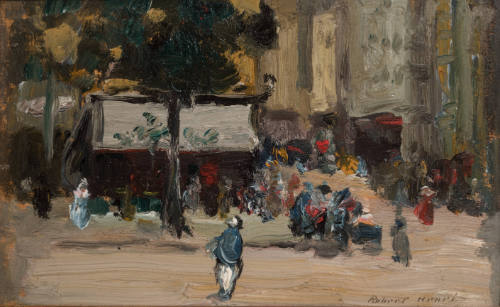
Robert Henri
1865
–1929
BirthplaceCincinnati, Ohio, United States of America
Death placeNew York, New York, United States of America
BiographyBorn in Cincinnati, Ohio, Robert Henri experienced a tumultuous childhood that led his family to move multiple times before settling in Atlantic City, New Jersey, when Henri was a teenager. In 1886 he enrolled at the Pennsylvania Academy of the Fine Arts in Philadelphia, Pennsylvania, and later traveled to Paris to study at the Academie Julian and the Ecole des Beaux-Arts. Henri’s European sojourn catalyzed his ideal that art should spring from an individual’s experience of life. This belief in the subjectivity of artistic expression became Henri’s working philosophy and shaped his choice of subjects and the style of his many paintings, particularly those of the city rendered in painterly dark tonalities.
In 1891 Henri returned to Philadelphia and re-enrolled at the Pennsylvania Academy to continue his studies; he also taught private art classes, which was how he met his first wife, Linda Craigie. While in Philadelphia he made the acquaintance of William Glackens, John Sloan, George Luks, and Everett Shinn – four artists and illustrators working for a local newspaper – and these five artists would form the core of a loose group that became known as the “Ashcan school,” all artists and followers of Henri who were inspired by his approach to art. Henri’s success in sharing his ideas garnered him a reputation as one of the nation’s most influential figures in the arts during the early decades of the twentieth century, and he taught and wrote about his methods.
Henri’s elevation of the experience of the artist led him to react against the conservatism of the art academies at which he had studied and taught, and compelled him to organize and participate in such infamous independent exhibitions as The Eight of 1908 and the Exhibition of Independent Artists of 1910 (often acknowledged as the prototype of the 1913 International Exhibition of Modern Art—the Armory Show). His second marriage in 1908 to artist Marjorie Organ (1886-1930) lasted until his death at age 64. His influential 1923 book The Art Spirit is still in print today.
In 1891 Henri returned to Philadelphia and re-enrolled at the Pennsylvania Academy to continue his studies; he also taught private art classes, which was how he met his first wife, Linda Craigie. While in Philadelphia he made the acquaintance of William Glackens, John Sloan, George Luks, and Everett Shinn – four artists and illustrators working for a local newspaper – and these five artists would form the core of a loose group that became known as the “Ashcan school,” all artists and followers of Henri who were inspired by his approach to art. Henri’s success in sharing his ideas garnered him a reputation as one of the nation’s most influential figures in the arts during the early decades of the twentieth century, and he taught and wrote about his methods.
Henri’s elevation of the experience of the artist led him to react against the conservatism of the art academies at which he had studied and taught, and compelled him to organize and participate in such infamous independent exhibitions as The Eight of 1908 and the Exhibition of Independent Artists of 1910 (often acknowledged as the prototype of the 1913 International Exhibition of Modern Art—the Armory Show). His second marriage in 1908 to artist Marjorie Organ (1886-1930) lasted until his death at age 64. His influential 1923 book The Art Spirit is still in print today.