
Raphael Soyer
1899
–1987
BirthplaceBorisogliebsk, Russia
Death placeNew York, New York, United States of America
BiographyAs a boy Raphael Soyer immigrated to the United States in 1912 with his Russian-Jewish family, who encouraged his interest in drawing; both Soyer's twin Moses (1899-1974) and their younger brother Isaac (1902-81) also went on to become artists. When the family settled in New York City in 1914, Raphael took classes at the Cooper Union, the National Academy of Design, and the Art Students League, where his teachers included Guy Pène du Bois (1884-1958), a painter of modern figural subjects. Soyer later claimed that his visits to New York's Metropolitan Museum of Art were the most important component of his artistic education.
In 1917, Soyer began making etchings on a small table-top press, working in his family's tenement home. Three years later, he began to make lithographs. Supporting himself with odd jobs, he pursued both painting and printmaking and soon became associated with the so-called Fourteenth Street School, a group of artists, including Pène du Bois, Peggy Bacon, Reginald Marsh, and Kenneth Hayes Miller, who were committed to portraying ordinary New York City life. In 1926, Soyer made the first of several extended visits to Europe; that year, his work was included in the independent “Salons of America" exhibition, and the following year he exhibited at the Whitney Studio Club (predecessor of the Whitney Museum of American Art). In 1929, New York's Daniel Gallery gave Soyer his first solo exhibition and by the early 1930s he was exhibiting works at important annual exhibitions at venues nationwide. In the 1930s he worked in the federally sponsored artists' relief projects that were part of the Works Project Administration (WPA), and he also became active in the leftist artists' movement, serving for example in the American Artists' Congress, a labor-rights organization.
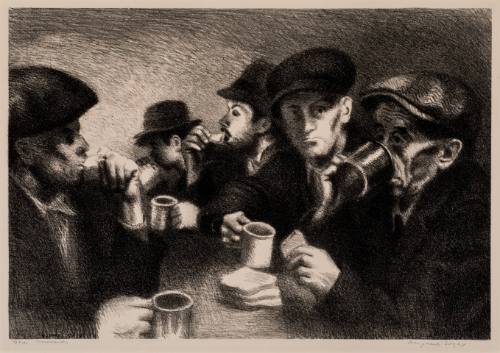
Before 1929, Soyer created images of family and friends, self-portraits, and scenes around his Manhattan neighborhood. Thereafter he drew his most characteristic subjects from the effects of the Great Depression on ordinary people. After his marriage in 1931, he also began to focus on the female nude and on scenes of generic women in ordinary domestic surroundings and in public places. Soyer began teaching at the John Reed Club in 1930 and taught at several New York institutions, including the National Academy of Design, into the 1960s.
In 1917, Soyer began making etchings on a small table-top press, working in his family's tenement home. Three years later, he began to make lithographs. Supporting himself with odd jobs, he pursued both painting and printmaking and soon became associated with the so-called Fourteenth Street School, a group of artists, including Pène du Bois, Peggy Bacon, Reginald Marsh, and Kenneth Hayes Miller, who were committed to portraying ordinary New York City life. In 1926, Soyer made the first of several extended visits to Europe; that year, his work was included in the independent “Salons of America" exhibition, and the following year he exhibited at the Whitney Studio Club (predecessor of the Whitney Museum of American Art). In 1929, New York's Daniel Gallery gave Soyer his first solo exhibition and by the early 1930s he was exhibiting works at important annual exhibitions at venues nationwide. In the 1930s he worked in the federally sponsored artists' relief projects that were part of the Works Project Administration (WPA), and he also became active in the leftist artists' movement, serving for example in the American Artists' Congress, a labor-rights organization.
Before 1929, Soyer created images of family and friends, self-portraits, and scenes around his Manhattan neighborhood. Thereafter he drew his most characteristic subjects from the effects of the Great Depression on ordinary people. After his marriage in 1931, he also began to focus on the female nude and on scenes of generic women in ordinary domestic surroundings and in public places. Soyer began teaching at the John Reed Club in 1930 and taught at several New York institutions, including the National Academy of Design, into the 1960s.