
Theodore Wendel
1859
–1932
BirthplaceMidway, Ohio, United States of America
Death placeIpswich, Massachusetts, United States of America
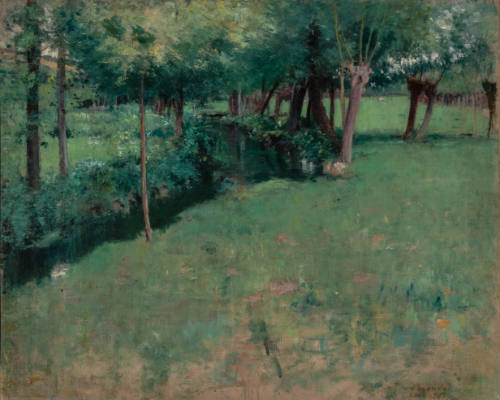
BiographyTheodore Wendel was born in Midway, Ohio, where his father, a German immigrant, ran a general store. He studied art in Cincinnati and there met the influential painter Frank Duveneck. In 1878, when Duveneck returned to Munich, Germany, where he had studied earlier in the decade, Wendel and his friend Joseph DeCamp joined him along with other Midwestern painters in an informal group known as the “Duveneck Boys.” Wendel took up etching, a print medium, in addition to painting. Working in Venice and Florence as well as Germany, he remained in Europe until 1882, when he returned to the United States to work successively in Newport, Rhode Island, New York City, Cincinnati, and Boston. In 1886, he returned to Europe and enrolled in the Académie Julian in Paris. He spent the summers of 1887 and 1888 in the rural Normandy village of Giverny, Claude Monet’s (1848-1926) adopted home. The landscape paintings Wendel made there are considered among the earliest by an American artist to incorporate the strategies of impressionism. When he returned to Boston in late 1888 and exhibited his French paintings in his studio in 1889, critics acknowledged Wendel’s full conversion to the new mode, evident especially in his use of bright colors and purple-blue shadows.
Based in Boston, where he was an instructor at Wellesley College and at the Cowles Art School, Wendel also taught and painted at Newport, Cape Ann, Gloucester, Massachusetts. Wendel’s paintings, pastels, and watercolors of coastal and rural settings were well received by Boston critics. In 1897, the artist married and made a two-year visit to Europe, touring France and Italy. On his return, he settled on a farm in coastal Ipswich, Massachusetts. The town's rural landscapes and village life inspired some of Wendel’s finest works. The artist retained his Boston studio, but a fire destroyed many of his earlier paintings. Wendel earned many prizes, including a silver medal at the Panama-Pacific Exposition of 1915. That year, the Guild of Boston Artists honored him with a solo exhibition.
Based in Boston, where he was an instructor at Wellesley College and at the Cowles Art School, Wendel also taught and painted at Newport, Cape Ann, Gloucester, Massachusetts. Wendel’s paintings, pastels, and watercolors of coastal and rural settings were well received by Boston critics. In 1897, the artist married and made a two-year visit to Europe, touring France and Italy. On his return, he settled on a farm in coastal Ipswich, Massachusetts. The town's rural landscapes and village life inspired some of Wendel’s finest works. The artist retained his Boston studio, but a fire destroyed many of his earlier paintings. Wendel earned many prizes, including a silver medal at the Panama-Pacific Exposition of 1915. That year, the Guild of Boston Artists honored him with a solo exhibition.