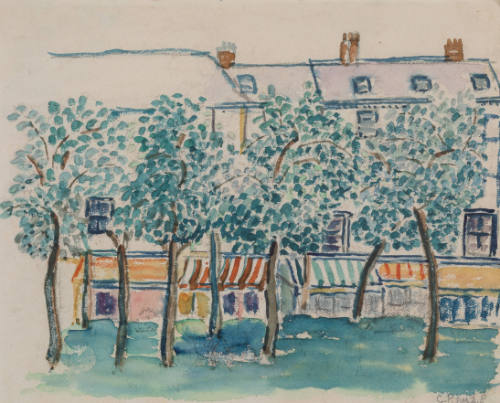
Grenoble
Artist
Charles Prendergast
(American, 1863–1948)
Date1927
MediumWatercolor and crayon on paper
DimensionsSheet: 7 1/4 x 9 3/4 in. (18.4 x 24.8 cm)
Credit LineTerra Foundation for American Art, Gift of Kraushaar Galleries, New York
Object number2012.1
InterpretationKnown for his intricately carved frames, panels, and decorated wooden objects, Charles Prendergast, the younger brother of artist Maurice Brazil Prendergast, shared his brother’s artistic sensibilities and love of color. As artistic colleagues and partners, Maurice and Charles Prendergast traveled extensively, drawing inspiration from the natural world, contemporary life, and mythology. After the death of Maruice in 1924, Charles traveld to France where he met Eugénie Van Kemmel (1894-1994), a Frenchwoman originally from Lille. The couple later married and returned to Europe in 1927 and 1929, touring the continent and visiting many cities in France. It was during one of these extended stays that Prendergast, then 64 years old, executed Grenoble.
The diminutive watercolor is a delicately rendered street scene depicting storefronts and buildings in Grenoble, a bustling city located in the foothills of the French Alps. Its splashes of bright colors and fluid lines imply Charles Prendergast’s loose handling, while the arboreal motifs suit his depiction of a leafy city nestled into a European mountain range, resonating with his lifelong engagement with the naturalistic themes of the Arts and Crafts movement.While Grenoble is not atypical of Prendergast’s work, it, along with the vast majority of his known watercolors, dates to the period following Maurice’s death in 1924. This concentration of watercolor works late in his life suggests that Charles turned to his beloved brother’s medium in the wake of the latter’s death.
The diminutive watercolor is a delicately rendered street scene depicting storefronts and buildings in Grenoble, a bustling city located in the foothills of the French Alps. Its splashes of bright colors and fluid lines imply Charles Prendergast’s loose handling, while the arboreal motifs suit his depiction of a leafy city nestled into a European mountain range, resonating with his lifelong engagement with the naturalistic themes of the Arts and Crafts movement.While Grenoble is not atypical of Prendergast’s work, it, along with the vast majority of his known watercolors, dates to the period following Maurice’s death in 1924. This concentration of watercolor works late in his life suggests that Charles turned to his beloved brother’s medium in the wake of the latter’s death.
Charles Prendergast: Watercolors, Carvings, Panels, Davis Galleries, New York, New York, October–November 1962, no. 2.
American Landscapes, David C. Driskell Center at the University of Maryland, College Park, Maryland. Venue: David C. Driskell Center, September 9–November 19, 2021. [exh. cat.]
American Landscapes, David C. Driskell Center at the University of Maryland, College Park, Maryland. Venue: David C. Driskell Center, September 9–November 19, 2021. [exh. cat.]
The David C. Driskell Center. American Landscapes. (exh. cat, The David C. Driskell Center at the University of Maryland, College Park). College Park, MD: The David C. Driskell Center, 2021. Ill. p. 85 (color).
Mrs. Elizabeth Page Simpson and William S. Simpson
Museum of Art, Science & Industry, Bridgeport, Connecticut
Kraushaar Galleries, New York, New York (dealer)
Terra Foundation for American Art, Chicago, Illinois, 2012