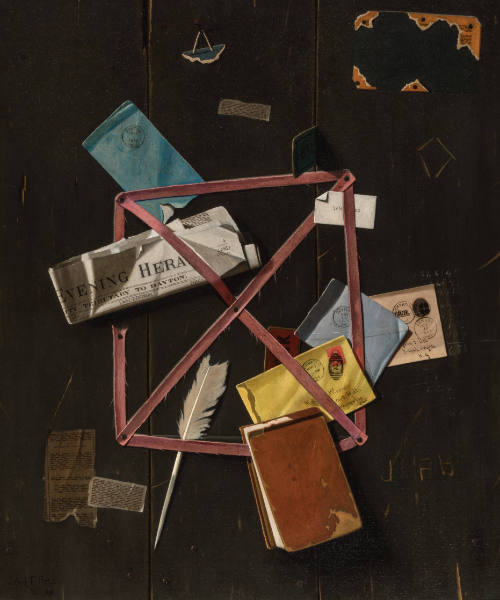
Old Time Letter Rack
Artist
John Frederick Peto
(American, 1854–1907)
Date1894
MediumOil on canvas
DimensionsImage: 30 1/8 x 25 1/4 in. (76.5 x 64.1 cm)
Frame: 42 1/2 x 37 1/2 x 4 5/8 in. (108 x 95.3 x 11.7 cm)
Frame: 42 1/2 x 37 1/2 x 4 5/8 in. (108 x 95.3 x 11.7 cm)
Credit LineTerra Foundation for American Art, Daniel J. Terra Art Acquisition Endowment Fund
Object number2015.5
SignedJohn F Peto/94
InterpretationJohn F. Peto's Old Time Letter Rack is an example of trompe l'oeil, a category of painting that creates the illustion of three-dimensional objects on a flat surface to “fool" or “deceive" the eye. A subset of trompe l’oeil painting, letter rack pictures were popular in the closing decades of the nineteenth century. Featuring painted tape “racks,” they displayed letters, newspaper clippings, photographs and other ephemera. Rack pictures were often commissioned by businesses or organizations for display in their offices, and their wide appeal pointed to the proliferation of printed material in the late nineteenth century, as technologically advanced printing processes became more affordable and the advent of photography transformed the visual culture of the period. John Frederick Peto painted numerous letter rack compositions, combining technical skill with compositional and thematic complexity. He made these paintings during two periods: the first, spanning the years 1879 to 1885, during which time his works featured complex grids with a plethora of calling cards and pamphlets; and his later period, from 1894 to 1907, with more simplified compositions.
Old Time Letter Rack dates to the beginning of this second phase and it, along with other rack paintings with the same title, capture the pathos and nostalgia characteristic of Peto’s work. It features a simplified rack made of wide, linear tapes that are broken and frayed, straining at the pins and fading in places. Objects strewn across the rack mirror the state of the tapes: torn or dilapidated, the letters, booklet, and news clippings have clearly been well-used. Artists often inserted word play, visual puns, and narrative meaning into their trompe l’oeil pictures from this period, and Peto was especially known for the subtle autobiographical hints he often inserted into his works. The worn state of the ephemera in Old Time Letter Rack may be one such layer. It is possible they reflect the artist's state of mind during this period as he suffered from the loss of his father and struggled financially. The newspaper and letters reinforce an autobiographical reading because they feature addresses and post stamps from Ohio where Peto and his wife lived briefly in 1894, the year of this painting.
In the decades after his death, much of Peto’s work came to be mistaken for that of his friend and colleague William Michael Harnett (1848–1892) who was a trompe l’oeil painter of far greater renown. Old Time Letter Rack exhibits the handling of color and texture that distinguishes Peto from Harnett. Far less invested in the “deception” of trompe l’oeil painting than Harnett, Peto’s painted surface has a soft, muted look, with a velvety appearance that softens its precise lines.
Old Time Letter Rack dates to the beginning of this second phase and it, along with other rack paintings with the same title, capture the pathos and nostalgia characteristic of Peto’s work. It features a simplified rack made of wide, linear tapes that are broken and frayed, straining at the pins and fading in places. Objects strewn across the rack mirror the state of the tapes: torn or dilapidated, the letters, booklet, and news clippings have clearly been well-used. Artists often inserted word play, visual puns, and narrative meaning into their trompe l’oeil pictures from this period, and Peto was especially known for the subtle autobiographical hints he often inserted into his works. The worn state of the ephemera in Old Time Letter Rack may be one such layer. It is possible they reflect the artist's state of mind during this period as he suffered from the loss of his father and struggled financially. The newspaper and letters reinforce an autobiographical reading because they feature addresses and post stamps from Ohio where Peto and his wife lived briefly in 1894, the year of this painting.
In the decades after his death, much of Peto’s work came to be mistaken for that of his friend and colleague William Michael Harnett (1848–1892) who was a trompe l’oeil painter of far greater renown. Old Time Letter Rack exhibits the handling of color and texture that distinguishes Peto from Harnett. Far less invested in the “deception” of trompe l’oeil painting than Harnett, Peto’s painted surface has a soft, muted look, with a velvety appearance that softens its precise lines.
Nature’s Banquet: American Paintings from the Manoogian Collection, Savannah College of Art and Design, Savannah, Georgia (organizer). Venue: Savannah College of Art and Design, Savannah, Georgia, January–March 2010. [exh. cat.]
Terra Collection-in-Residence, Georgia Museum of Art, Athens, Georgia, June 1, 2022–June 30, 2026.
Terra Collection-in-Residence, Georgia Museum of Art, Athens, Georgia, June 1, 2022–June 30, 2026.
John Moran Auctioneers, Altadena, California (California and American Paintings Sale, October 17, 2006): lot 53. Text pp. 5-6; ill. lot 53 (color).
Nature’s Banquet: American Paintings from the Manoogian Collection and Small Treasures of 19th-Century American Art, (exh. cat., Savannah College of Art and Design). Savannah, Georgia: Savannah College of Art and Design, 2010. Text, checklist, cat. no. 19; ill. cat. no. 19 (color).
Sotheby’s, New York, New York (Sale N09350, May 20, 2015): lot 24. Text p. 46, lot 24; ill. p. 47 (color).
Bourguignon, Katherine M., and Peter John Brownlee, eds. Conversations with the Collection: A Terra Foundation Collection Handbook. Chicago: Terra Foundation for American Art, 2018. Text p. 110; ill. p. 110 (color).
Nature’s Banquet: American Paintings from the Manoogian Collection and Small Treasures of 19th-Century American Art, (exh. cat., Savannah College of Art and Design). Savannah, Georgia: Savannah College of Art and Design, 2010. Text, checklist, cat. no. 19; ill. cat. no. 19 (color).
Sotheby’s, New York, New York (Sale N09350, May 20, 2015): lot 24. Text p. 46, lot 24; ill. p. 47 (color).
Bourguignon, Katherine M., and Peter John Brownlee, eds. Conversations with the Collection: A Terra Foundation Collection Handbook. Chicago: Terra Foundation for American Art, 2018. Text p. 110; ill. p. 110 (color).
Private collection, Los Angeles, California, until 2006
Private estate, Los Angeles, California, 2006
Mr. Richard Manoogian and Mrs. Jane Manoogian, Detroit, Michigan, October 17, 2006 (acquired from John Moran Auctioneers, Altadena, California, October 17, 2006, lot 53)
Terra Foundation for American Art, 2015 (acquired from Sotheby’s, New York, New York, May 20, 2015, lot 24)