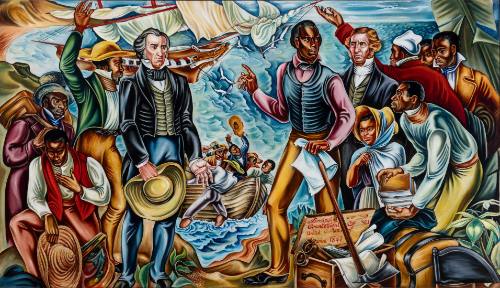
The Repatriation of the Freed Captives
Artist
Hale A. Woodruff
(American, 1900 – 1980)
Artist
Robert L. Neal
(American, 1916 – 1987)
Date1939
MediumOil on canvas
DimensionsImage: 71 3/8 x 123 7/8 in. (181.3 x 314.6 cm.)
Credit LineCo-stewarded by Terra Foundation for American Art, Daniel J. Terra Art Acquisition Fund, and Art Bridges Foundation. Commissioned by Buell G. Gallagher and George W. Crawford for Talladega College, Savery Library, Alabama. The commission was supported in part by the American Missionary Association of New York (AMA), TCA2025.4, AB.2025.65
Object numberTCA2025.4
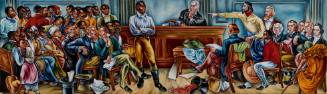
InterpretationAmerican artist and art historian James A. Porter, in Modern Negro Art (1943), comments on the Amistad Series mural paintings by Hale A. Woodruff, assisted by Robert Neal: “Where in all American art can one find a more remarkable grouping of black and white faces than in the second panel of this series, showing the slaves(1) on trial at New Haven, Connecticut? Apart from the thorough research the artist has devoted to the figures' costumes, there is also a variety of posture, gesture, facial expression, and grouping that builds the ‘psychological motif’ or the dramatic tension of the whole. It must be conceded that Woodruff not only exhibits a fine sense of design but also shows himself gifted with the retrospective imagination that is as indispensable to the great mural artist as to the historian [. . .] The entire series of panels is a delight to the eye.”
It was 1938, and racial tensions were high across Depression-era America. Talladega College President Buell G. Gallagher (1904–1978) believed that a new library on the college’s campus, intended for students, faculty, and Talladega residents, would be a statement of “interracial harmony and intellectual advancement.” Gallagher, an educator, writer, administrator, and champion of social change, had been commissioned by the American Missionary Association (AMA) to lead Talladega. He planned the new library in partnership with George W. Crawford (1877–1972), the college’s Board of Trustees chair. Crawford was a member of Talladega’s class of 1900 and a Yale Law School graduate (1903) who was awarded the prestigious Townsend Prize for oration while attending the school. He was also a member of the AMA.
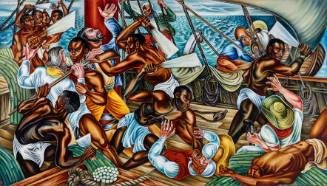
Gallagher and Crawford commissioned artist Hale A. Woodruff to paint a series of large canvases for the library's lobby. The AMA provided full financial support to Woodruff. Three of these murals depict the story of the 1839 Amistad incident and its aftermath.
Woodruff’s three Amistad murals reimagined the theme of African resistance for contemporary times. In bold, animated forms and evocative imagery, Woodruff began his series with a depiction of the moment when the kidnapped Africans retaliated against the ship’s crew. In the next mural, the Africans face their accusers in a lower court trial, supported by the abolitionist coalition that would become known as the Amistad Committee. This early iteration of the AMA soon enlisted former US President John Quincy Adams to lead the defense of the captives before the Supreme Court.
The murals present an international, historical account of persons of African descent in the Americas. From the 1960s until his death, Hale Woodruff continued to create and collaborate with other African American artists. In particular, his art included the Celestial Gate series, which began in the early 1950s and continued to add to through the late 1970s. This series showcased his deft ability to work abstractly and incorporate traditional African iconography.
(1) Porter uses the term “slaves,” which should be “captives,” as the defense in the Amistad case proved that the African captives were not enslaved but free persons.
It was 1938, and racial tensions were high across Depression-era America. Talladega College President Buell G. Gallagher (1904–1978) believed that a new library on the college’s campus, intended for students, faculty, and Talladega residents, would be a statement of “interracial harmony and intellectual advancement.” Gallagher, an educator, writer, administrator, and champion of social change, had been commissioned by the American Missionary Association (AMA) to lead Talladega. He planned the new library in partnership with George W. Crawford (1877–1972), the college’s Board of Trustees chair. Crawford was a member of Talladega’s class of 1900 and a Yale Law School graduate (1903) who was awarded the prestigious Townsend Prize for oration while attending the school. He was also a member of the AMA.
Gallagher and Crawford commissioned artist Hale A. Woodruff to paint a series of large canvases for the library's lobby. The AMA provided full financial support to Woodruff. Three of these murals depict the story of the 1839 Amistad incident and its aftermath.
Woodruff’s three Amistad murals reimagined the theme of African resistance for contemporary times. In bold, animated forms and evocative imagery, Woodruff began his series with a depiction of the moment when the kidnapped Africans retaliated against the ship’s crew. In the next mural, the Africans face their accusers in a lower court trial, supported by the abolitionist coalition that would become known as the Amistad Committee. This early iteration of the AMA soon enlisted former US President John Quincy Adams to lead the defense of the captives before the Supreme Court.
The murals present an international, historical account of persons of African descent in the Americas. From the 1960s until his death, Hale Woodruff continued to create and collaborate with other African American artists. In particular, his art included the Celestial Gate series, which began in the early 1950s and continued to add to through the late 1970s. This series showcased his deft ability to work abstractly and incorporate traditional African iconography.
(1) Porter uses the term “slaves,” which should be “captives,” as the defense in the Amistad case proved that the African captives were not enslaved but free persons.
Installed Savery Library, Talladega College, Alabama, April 15, 1939.
Rising Up: Hale Woodruff’s Murals at Talladega College, High Museum of Art, June 9–September 2, 2012.
African American Museum, Dallas, October 6, 2012–February 28, 2013.
80 WSE Gallery at New York University Steinhardt, July 20–October 13, 2013.
National Museum of African American History and Culture, Smithsonian Institution, Washington, DC, November 22, 2013–March 2, 2014.
New Orleans Museum of Art, June 13–September 14, 2014.
The Amistad Center for Art and Culture, Inc. at the Wadsworth Atheneum and Museum of Art and Connecticut’s Old State House, Hartford, Connecticut, October 4, 2014–March 1, 2015.
Birmingham Museum of Art, Birmingham, Alabama, June 4, 2014–March 1, 2015.
Rising Up: Hale Woodruff’s Murals at Talladega College, High Museum of Art, June 9–September 2, 2012.
African American Museum, Dallas, October 6, 2012–February 28, 2013.
80 WSE Gallery at New York University Steinhardt, July 20–October 13, 2013.
National Museum of African American History and Culture, Smithsonian Institution, Washington, DC, November 22, 2013–March 2, 2014.
New Orleans Museum of Art, June 13–September 14, 2014.
The Amistad Center for Art and Culture, Inc. at the Wadsworth Atheneum and Museum of Art and Connecticut’s Old State House, Hartford, Connecticut, October 4, 2014–March 1, 2015.
Birmingham Museum of Art, Birmingham, Alabama, June 4, 2014–March 1, 2015.
Crawford, George W. “The Rising Generation and the Door of Hope.” The American Missionary 58, no. 2 (1904): 37–42.
Beard, Augustus Field. A Crusade of Brotherhood: A History of the American Missionary Association. Boston: The Pilgrim Press, 1909.
“College President at 29; The Rev. B.G. Gallagher of Passaic Is Elected at Talladega.” New York Times, July 25, 1933, 10.
Blanchard, F. Q. “A Quarter Century in the American Missionary Association.” Journal of Negro Education (1937): 152–56.
Johnson, Charles S. “The American Missionary Association Institute of Race Relations.” Journal of Negro Education 13 (1944): 568–74.
McPherson, James M. The Struggle for Equality: Abolitionists and the Negro in the Civil War and Reconstruction. Princeton, NJ: Princeton University Press, 1964.
Richardson, Joe M. “Fisk University: The First Critical Years.” Tennessee Historical Quarterly 29, no. 1 (1970): 24–41.
Richardson, Joe M. “Christian Abolitionism: The American Missionary Association and the Florida Negro.” Journal of Negro Education 40, no. 1 (1971): 35–44.
Crawford, George W. Thirty-four Selected Opinions of George W. Crawford, New Haven, CT: Corporation Counsel of the City of New Haven, 1972.
Richardson, Joe M. “‘We Are Truly Doing Missionary Work’: Letters from American Missionary Association Teachers in Florida, 1864–1874.” Florida Historical Quarterly 54, no. 2 (1975): 178–95.
Jones, Jacqueline. “Women Who Were More Than Men: Sex and Status in Freedmen's Teaching.” History of Education Quarterly 19, no. 1 (1979): 47–59.
Brady, Patricia. “Trials and Tribulations: American Missionary Association Teachers and Black Education in Occupied New Orleans, 1863–1864.” Louisiana History 31, no. 1 (1990): 5–20.
McPherson, James M. The Abolitionist Legacy: From Reconstruction to the NAACP. Princeton, NJ: Princeton University Press, 1995.
Richardson, E. Allen. “Architects of a Benevolent Empire: The Relationship Between the American Missionary Association and the Freedmen's Bureau in Virginia, 1865–1872.” In The Freedmen's Bureau and Reconstruction: Reconsiderations, edited by Paul A. Cimbala and Randall M. Miller, 119–39. New York: Fordham University Press, 1999.
Click, Patricia C. Time Full of Trial: The Roanoke Island Freedmen’s Colony, 1862–1867. Chapel Hill: University of North Carolina Press, 2003.
Van Nort, Sydney C. The City College of New York. Charleston, SC: Arcadia Press, 2007.
Richardson, Joe M. Christian Reconstruction: The American Missionary Association and Southern Blacks, 1861–1890. Tuscaloosa: University of Alabama Press, 2009.
Richardson, Joe M., and Maxine D. Jones. Education for Liberation: The American Missionary Association and African Americans, 1890 to the Civil Rights Movement. Tuscaloosa: University of Alabama Press, 2015.
DeBoer, Clara Merritt. His Truth Is Marching On: African Americans Who Taught the Freedmen for the American Missionary Association, 1861–1877. New York: Routledge, 2016.
Blight, David W. Yale and Slavery: A History. New Haven, CT: Yale University Press, 2024.
Beard, Augustus Field. A Crusade of Brotherhood: A History of the American Missionary Association. Boston: The Pilgrim Press, 1909.
“College President at 29; The Rev. B.G. Gallagher of Passaic Is Elected at Talladega.” New York Times, July 25, 1933, 10.
Blanchard, F. Q. “A Quarter Century in the American Missionary Association.” Journal of Negro Education (1937): 152–56.
Johnson, Charles S. “The American Missionary Association Institute of Race Relations.” Journal of Negro Education 13 (1944): 568–74.
McPherson, James M. The Struggle for Equality: Abolitionists and the Negro in the Civil War and Reconstruction. Princeton, NJ: Princeton University Press, 1964.
Richardson, Joe M. “Fisk University: The First Critical Years.” Tennessee Historical Quarterly 29, no. 1 (1970): 24–41.
Richardson, Joe M. “Christian Abolitionism: The American Missionary Association and the Florida Negro.” Journal of Negro Education 40, no. 1 (1971): 35–44.
Crawford, George W. Thirty-four Selected Opinions of George W. Crawford, New Haven, CT: Corporation Counsel of the City of New Haven, 1972.
Richardson, Joe M. “‘We Are Truly Doing Missionary Work’: Letters from American Missionary Association Teachers in Florida, 1864–1874.” Florida Historical Quarterly 54, no. 2 (1975): 178–95.
Jones, Jacqueline. “Women Who Were More Than Men: Sex and Status in Freedmen's Teaching.” History of Education Quarterly 19, no. 1 (1979): 47–59.
Brady, Patricia. “Trials and Tribulations: American Missionary Association Teachers and Black Education in Occupied New Orleans, 1863–1864.” Louisiana History 31, no. 1 (1990): 5–20.
McPherson, James M. The Abolitionist Legacy: From Reconstruction to the NAACP. Princeton, NJ: Princeton University Press, 1995.
Richardson, E. Allen. “Architects of a Benevolent Empire: The Relationship Between the American Missionary Association and the Freedmen's Bureau in Virginia, 1865–1872.” In The Freedmen's Bureau and Reconstruction: Reconsiderations, edited by Paul A. Cimbala and Randall M. Miller, 119–39. New York: Fordham University Press, 1999.
Click, Patricia C. Time Full of Trial: The Roanoke Island Freedmen’s Colony, 1862–1867. Chapel Hill: University of North Carolina Press, 2003.
Van Nort, Sydney C. The City College of New York. Charleston, SC: Arcadia Press, 2007.
Richardson, Joe M. Christian Reconstruction: The American Missionary Association and Southern Blacks, 1861–1890. Tuscaloosa: University of Alabama Press, 2009.
Richardson, Joe M., and Maxine D. Jones. Education for Liberation: The American Missionary Association and African Americans, 1890 to the Civil Rights Movement. Tuscaloosa: University of Alabama Press, 2015.
DeBoer, Clara Merritt. His Truth Is Marching On: African Americans Who Taught the Freedmen for the American Missionary Association, 1861–1877. New York: Routledge, 2016.
Blight, David W. Yale and Slavery: A History. New Haven, CT: Yale University Press, 2024.
Terra Foundation for American Art and Art Bridges Foundation, 2026