Untitled
Artist
Beulah Loomis Hyde
(American, 1886 – 1983)
Dateca. 1935-40
MediumOil on canvas
DimensionsImage: 20 x 16 in. (50.8 x 40.64 cm)
Frame: 27 1/4 x 23 1/4 in. (69.22 x 59.1 cm)
Frame: 27 1/4 x 23 1/4 in. (69.22 x 59.1 cm)
Credit LineTerra Foundation for American Art, Gift of the B.L. Hyde Estate
Object number2026.1
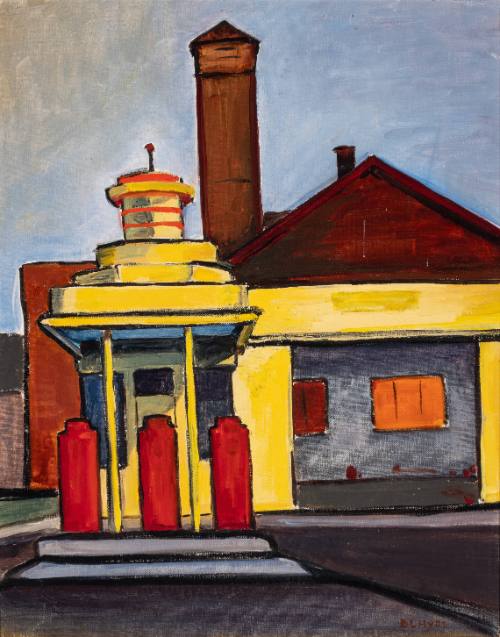
InterpretationBright yellow and red dominate this untitled architectural scene. A kiosk dominates the foreground, with three bold red vertical gas pumps that anchor it visually. Behind this central structure is a tall smokestack. Architectural elements to the right, rendered as blocky, simplified forms in muted reds, browns, and grays, reinforce a geometric, simplified approach. People are absent from this scene, which seems frozen in time.
B. L. Hyde depicted industrial and everyday structures with clean lines and a sense of quiet, empty stillness. In this way, her work from the 1930s and 1940s aligns with Precisionism, a movement characterized by streamlined, geometric industrial scenes by artists such as Charles Sheeler and Charles Demuth. This painting also calls to mind the empty urban scenes of Edward Hopper, whose canvases often have a contemplative mood, and the simplified depictions of rural barns by Georgia O'Keeffe in the 1920s and 1930s. This empty scene, devoid of figures and details, evokes both mobility and alienation within the modern landscape.
This work may be the painting titled Gas Station, which won second prize at the Contemporary American Art exhibition in Puyallup, Washington, in 1941. However, since B. L. Hyde never dated her artwork, rarely assigned exact titles, and produced other paintings depicting gas stations, precise identification is impossible.
B. L. Hyde depicted industrial and everyday structures with clean lines and a sense of quiet, empty stillness. In this way, her work from the 1930s and 1940s aligns with Precisionism, a movement characterized by streamlined, geometric industrial scenes by artists such as Charles Sheeler and Charles Demuth. This painting also calls to mind the empty urban scenes of Edward Hopper, whose canvases often have a contemplative mood, and the simplified depictions of rural barns by Georgia O'Keeffe in the 1920s and 1930s. This empty scene, devoid of figures and details, evokes both mobility and alienation within the modern landscape.
This work may be the painting titled Gas Station, which won second prize at the Contemporary American Art exhibition in Puyallup, Washington, in 1941. However, since B. L. Hyde never dated her artwork, rarely assigned exact titles, and produced other paintings depicting gas stations, precise identification is impossible.
Possible: Contemporary American Art, Western Washington Fair Art Galleries, Puyallup, WA, 1941, as Gas Station.
Structure and Form: The Art of B. L. Hyde, Cascadia Art Museum (October 10, 2024–February 2, 2025) [exhibition catalogue].
Structure and Form: The Art of B. L. Hyde, Cascadia Art Museum (October 10, 2024–February 2, 2025) [exhibition catalogue].
Martin, David F. Structure and Form: The Art of B. L. Hyde. Edmonds, WA: Cascadia Art Museum, 2024. Illustrated, p. 97 (color).
Pamela Hyde Smith (descended in the family)
Terra Foundation for American Art, 2026