January
Artist
Grant Wood
(American, 1891–1942)
Date1938
MediumLithograph on BFK Rives off-white wove paper
DimensionsImage: 8 15/16 x 11 7/8 in. (22.7 x 30.2 cm)
Sheet: 11 7/8 x 14 1/4 in. (30.2 x 36.2 cm)
Mat: 16 x 20 in. (40.6 x 50.8 cm)
Sheet: 11 7/8 x 14 1/4 in. (30.2 x 36.2 cm)
Mat: 16 x 20 in. (40.6 x 50.8 cm)
Credit LineTerra Foundation for American Art, Daniel J. Terra Collection
Object number1995.54
SignedIn graphite, lower right: Grant Wood
CopyrightArt © Figge Art Museum, successors to the Estate of Nan Wood Graham/Licensed by VAGA, New York, NY
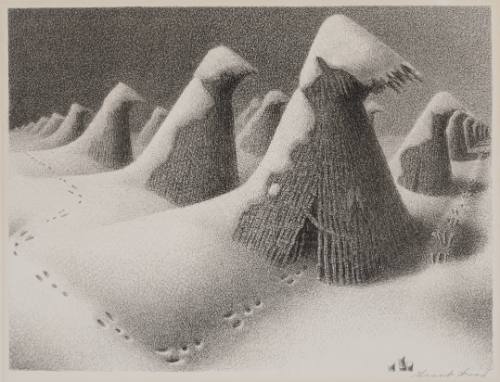
InterpretationIn Grant Wood's snow-covered farm scene entitled January, rows of conical, snow-covered stacks of corn stalks recede into the distance beneath a gray sky. The only signs of life are a scampering rabbit's tracks, which lead to a gap at the base of the nearest stack. Writing to a collector in 1941, the artist explained, “Here in Iowa the winters are severe…but…one does not get the feeling of utter bleakness and desolation….The farmhouses are snug, the barns well stored: it is a land of plenty here which seems to rest, rather than suffer, under the cold. In light of this, it seemed to me that nothing caught the spirit of an Iowan winter more aptly than the familiar scene of a field of corn shocks partly covered with snow. The rabbit tracks, leading into the snug shelter of the shock in the foreground are a piece of symbolism with which I had some fun." In 1940, Wood made a related painting, also titled January (Cleveland Museum of Art).
During the 1930s, Wood's paintings of rural scenes brought him fame and professional opportunities, yet the financial difficulties of the Depression encouraged him to pursue printmaking to supplement his income. Between 1937 and 1941, Wood made nineteen lithographs in the same carefully controlled style as his paintings and characterized by a gray, chalky texture and tonality. All but one of the lithographs were commissioned by Associated American Artists, a New York gallery that helped artists by offering the public original works of graphic art at affordable prices. Wood's lithographs were printed by George C. Miller (1894-1965), the renowned master printer based in New York. After drawing on the lithograph stones in his Iowa studio, Wood shipped them to Miller, who sent proofs back to Wood for his approval before printing the editions; except for Sultry Night (TF 1996.78), these each consisted of 250 impressions.
Wood more typically pictured spring, summer, and autumn scenes, but between 1937 and 1941 he created four lithographs of rural scenes representing—and titled for—each of the winter months from December through March. January exemplifies Wood's powerful evocation of the mysterious beauty inherent in rural scenes.
During the 1930s, Wood's paintings of rural scenes brought him fame and professional opportunities, yet the financial difficulties of the Depression encouraged him to pursue printmaking to supplement his income. Between 1937 and 1941, Wood made nineteen lithographs in the same carefully controlled style as his paintings and characterized by a gray, chalky texture and tonality. All but one of the lithographs were commissioned by Associated American Artists, a New York gallery that helped artists by offering the public original works of graphic art at affordable prices. Wood's lithographs were printed by George C. Miller (1894-1965), the renowned master printer based in New York. After drawing on the lithograph stones in his Iowa studio, Wood shipped them to Miller, who sent proofs back to Wood for his approval before printing the editions; except for Sultry Night (TF 1996.78), these each consisted of 250 impressions.
Wood more typically pictured spring, summer, and autumn scenes, but between 1937 and 1941 he created four lithographs of rural scenes representing—and titled for—each of the winter months from December through March. January exemplifies Wood's powerful evocation of the mysterious beauty inherent in rural scenes.
Visions of a Nation: Exploring Identity through American Art, Terra Museum of American Art, Chicago, Illinois (organizer). Venue: Terra Museum of American Art, Chicago, Illinois, August 10, 1996–January 12, 1997.
On Process: The American Print, Technique Examined, Terra Museum of American Art, Chicago, Illinois (organizer). Venue: Terra Museum of American Art, Chicago, Illinois, January 13–March 2, 2001.
America’s Cool Modernism: O’Keeffe to Hopper, Terra Foundation for American Art and the Ashmolean Museum of Art & Archaeology, Oxford, UK (organizers.) Venue: Ashmolean Museum of Art & Archaeology, Oxford, UK, March 23, 2018–July 22, 2018 [exh. cat.]
On Process: The American Print, Technique Examined, Terra Museum of American Art, Chicago, Illinois (organizer). Venue: Terra Museum of American Art, Chicago, Illinois, January 13–March 2, 2001.
America’s Cool Modernism: O’Keeffe to Hopper, Terra Foundation for American Art and the Ashmolean Museum of Art & Archaeology, Oxford, UK (organizers.) Venue: Ashmolean Museum of Art & Archaeology, Oxford, UK, March 23, 2018–July 22, 2018 [exh. cat.]
Craven, Thomas, ed. A Treasury of American Prints: A Selection of One Hundred Etchings and Lithographs by the Foremost Living American Artists. New York: Simon and Schuster, 1939. Pl. 92.
The Grant Wood Collection, Cedar Rapids Art Center. Cedar Rapids, Iowa: Cedar Rapids Art Center, 1973. No. 93.
Dennis, James M. Grant Wood: A Study in American Art and Culture. New York: Viking Press, 1975. Text p. 201; fig. 165.
Czestochowski, Joseph S. John Steuart Curry and Grant Wood: A Portrait of Rural America. Columbia, Missouri and Cedar Rapids, Iowa: University of Missouri Press and Cedar Rapids Art Association, 1981. No. W-5, p. 208.
Corn, Wanda M. Grant Wood: The Regionalist Vision. New Haven, Connecticut and London, England: Yale University Press for the Minneapolis Institute of Arts, 1983. Fig. 86, p. 51.
Cole, Sylvan, Jr. Grant Wood: The Lithographs; A Catalogue Raisonné. New York: Associated American Artists, 1984. No. 3.
Master Prints of Five Centuries: The Alan and Marianne Schwartz Collection. (exh. cat., The Detroit Institute of Arts). Detroit, Michigan: The Detroit Institute of Arts, 1990. No. 124, p. 133.
The Gloria and Donald B. Marron Collection of American Prints. (exh. cat., Santa Barbara Museum of Art). Santa Barbara, California: Santa Barbara Museum of Art, 1981. No. 93, p. 133.
Bourguignon, Katherine M., Lauren Kroiz, and Leo G. Mazow. Cool Modernism: O’Keeffe to Hopper. Oxford, United Kingdom: Ashmolean Museum of Art & Archaeology–University of Oxford, 2018. Text. pp. 50, 51, 52, cat. no. 89 (checklist); ill. pp. 50, 174 (color).
The Grant Wood Collection, Cedar Rapids Art Center. Cedar Rapids, Iowa: Cedar Rapids Art Center, 1973. No. 93.
Dennis, James M. Grant Wood: A Study in American Art and Culture. New York: Viking Press, 1975. Text p. 201; fig. 165.
Czestochowski, Joseph S. John Steuart Curry and Grant Wood: A Portrait of Rural America. Columbia, Missouri and Cedar Rapids, Iowa: University of Missouri Press and Cedar Rapids Art Association, 1981. No. W-5, p. 208.
Corn, Wanda M. Grant Wood: The Regionalist Vision. New Haven, Connecticut and London, England: Yale University Press for the Minneapolis Institute of Arts, 1983. Fig. 86, p. 51.
Cole, Sylvan, Jr. Grant Wood: The Lithographs; A Catalogue Raisonné. New York: Associated American Artists, 1984. No. 3.
Master Prints of Five Centuries: The Alan and Marianne Schwartz Collection. (exh. cat., The Detroit Institute of Arts). Detroit, Michigan: The Detroit Institute of Arts, 1990. No. 124, p. 133.
The Gloria and Donald B. Marron Collection of American Prints. (exh. cat., Santa Barbara Museum of Art). Santa Barbara, California: Santa Barbara Museum of Art, 1981. No. 93, p. 133.
Bourguignon, Katherine M., Lauren Kroiz, and Leo G. Mazow. Cool Modernism: O’Keeffe to Hopper. Oxford, United Kingdom: Ashmolean Museum of Art & Archaeology–University of Oxford, 2018. Text. pp. 50, 51, 52, cat. no. 89 (checklist); ill. pp. 50, 174 (color).
Margo Pollins Schab, Inc., New York, New York
Terra Foundation for the Arts Collection, Chicago, Illinois, 1995