Dancing Figures
Artist
Emil Bisttram
(American, 1895–1976)
Date1941
MediumCrayon, graphite and watercolor on tan wove paper
DimensionsOverall: 12 x 18 in. (30.5 x 45.7 cm)
Credit LineTerra Foundation for American Art, Gift of Aaron Galleries
Object numberC1993.27
SignedLower right: BISTTRAM/41
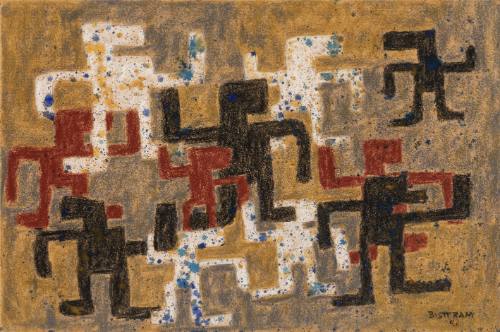
InterpretationBlack, brownish-red, and white dancing figures, reduced to flat, angular, yet recognizable shapes, overlap and interweave as they spread across a flat field of light-brown and dull yellow in Emil Bisttram's Dancing Figures. Speckles of blue, flicked directly from the brush to adhere most visibly to the white forms, inflect the earth-tones of the painting. The arrangement of the figures and the alternating positions of arms and heads create a rhythmic pattern across the paper. In addition to a group of dancing figures, Bisttram's composition also can be read as a random arrangement of abstract shapes with contrasting angles, their earthy colors complemented by the sketchy application of the crayon medium to highlight the rough texture of the tan paper beneath.
Bisttram moved to Taos, New Mexico in the 1930s and his work became increasingly abstract as he pursued spiritual and philosophical interests. In the 1920s he had adopted a compositional strategy founded on the Golden Ratio called “dynamic symmetry”. In works like Dancing Figures and Mother Earth (C1993.26), as well as in representational works like portraits and murals, Bisttram utilized an underlying framework of symmetrical squares and triangles to “create order out of chaos.” Combined with a growing interest in Theosophy, (a 19th-century form of occultism based on multiple world religions), meditation, and cosmology, a work like Dancing Figures shares elements of both mathematical geometry, with its square-shaped figures, as well as elements of mysticism, to allow for an open-ended interpretation of the work’s meaning.
Bisttram moved to Taos, New Mexico in the 1930s and his work became increasingly abstract as he pursued spiritual and philosophical interests. In the 1920s he had adopted a compositional strategy founded on the Golden Ratio called “dynamic symmetry”. In works like Dancing Figures and Mother Earth (C1993.26), as well as in representational works like portraits and murals, Bisttram utilized an underlying framework of symmetrical squares and triangles to “create order out of chaos.” Combined with a growing interest in Theosophy, (a 19th-century form of occultism based on multiple world religions), meditation, and cosmology, a work like Dancing Figures shares elements of both mathematical geometry, with its square-shaped figures, as well as elements of mysticism, to allow for an open-ended interpretation of the work’s meaning.
Figures and Forms: Selections from the Terra Foundation for the Arts, Terra Museum of American Art, Chicago, Illinois (organizer). Venue: Terra Museum of American Art, Chicago, Illinois, May 9–July 9, 2000.
L'Amérique et les modernes, 1900–1950 (American Moderns, 1900–1950), Musée d'Art Américain Giverny, France (organizer). Venue: Musée d'Art Américain Giverny, France, July 25–October 31, 2000. [exh. cat.]
L'Amérique et les modernes, 1900–1950 (American Moderns, 1900–1950), Musée d'Art Américain Giverny, France (organizer). Venue: Musée d'Art Américain Giverny, France, July 25–October 31, 2000. [exh. cat.]
Gustafson, Elaine D. and Susan E. Strickler. The Second Wave: American Abstraction of the 1930s and 1940s. Worcester, Massachusetts: Worcester Art Museum, 1991, pp. 114–15.
Cartwright, Derrick R. and Paul J. Karlstrom. American Moderns, 1900–1950. (exh. cat., Musée d'Art Américain Giverny). Chicago, Illinois: Terra Foundation for the Arts, 2000. Text p. 60 (checklist); pl. 5, p. 32 (color).
Cartwright, Derrick R. and Paul J. Karlstrom. L'Amérique et les modernes, 1900–1950. (exh. cat., Musée d'Art Américain Giverny). Chicago, Illinois: Terra Foundation for the Arts, 2000. Text p. 60 (checklist); pl. 5, p. 32 (color).
Cartwright, Derrick R. and Paul J. Karlstrom. American Moderns, 1900–1950. (exh. cat., Musée d'Art Américain Giverny). Chicago, Illinois: Terra Foundation for the Arts, 2000. Text p. 60 (checklist); pl. 5, p. 32 (color).
Cartwright, Derrick R. and Paul J. Karlstrom. L'Amérique et les modernes, 1900–1950. (exh. cat., Musée d'Art Américain Giverny). Chicago, Illinois: Terra Foundation for the Arts, 2000. Text p. 60 (checklist); pl. 5, p. 32 (color).
Aaron Galleries, Chicago, Illinois
Terra Foundation for the Arts Collection, Chicago, Illinois, 1993 (gift of Aaron Galleries)