
Rose B. Simpson
born
1983
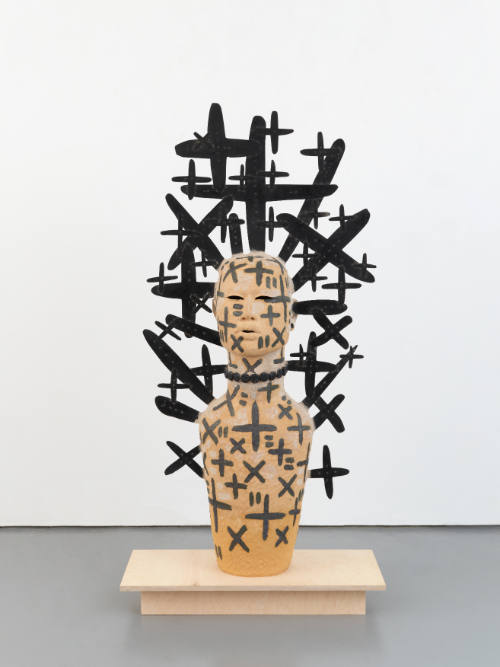
Rose Simpson’s human-like clay sculptures, adorned with beads, ropes, smaller sculptures, painted marks, and protruding steel symbols, serve as energetic beings, according to the artist. As she has explained, they exist in the world to hold space as both vessels for and witnesses to the wide range of transitions, understandings, and perspectives that humans experience.
Rose Simpson was born in 1983 in Santa Clara Pueblo, New Mexico, into an illustrious line of Kha’po Owingeh (Santa Clara Pueblo) women who were also artists, architects, and makers. Her mother, Roxanne Swentzell, is a renowned ceramicist; her grandmother, Rina Swentzell, was an architect and a potter; and her great-grandmother, Rose Naranjo, shared her pottery-making skills with her children. Both artmaking and utilizing clay as a medium are part of Simpson’s heritage. Simpson studied at the University of New Mexico and the Institute of American Indian Arts, where she received her BFA in 2007. She received her MFA from the Rhode Island School of Design in 2011 and then returned to Santa Clara Pueblo, where she lives and has a studio.
To build her figural sculptures, Simpson uses a technique she developed which she calls “slap-slab," a dynamic form of slab sculpture—a process whereby a ceramic vessel is hand-built versus thrown on a pottery wheel—that involves slapping the clay on the floor several times to make it very thin, before applying it to the work-in-progress. This approach is necessarily fast and demands the artist’s full presence in the building process; Simpson cannot return later to a sculpture and carve down or re-shape elements. The artist’s sculptures also feature her own language of signs and adornment, elements of empowerment that mark the passing of time and the process of becoming.
Simpson is the recipient of a Joan Mitchell Foundation Fellowship and a Women’s Caucus for Art President’s Award for Art & Activism and is represented in collections including the Cleveland Museum of Art, Denver Art Museum, Forge Project, Museum of Contemporary Art Chicago, Museum of Fine Arts Boston, Princeton University Art Museum, and San Francisco Museum of Modern Art, among others.
Rose Simpson was born in 1983 in Santa Clara Pueblo, New Mexico, into an illustrious line of Kha’po Owingeh (Santa Clara Pueblo) women who were also artists, architects, and makers. Her mother, Roxanne Swentzell, is a renowned ceramicist; her grandmother, Rina Swentzell, was an architect and a potter; and her great-grandmother, Rose Naranjo, shared her pottery-making skills with her children. Both artmaking and utilizing clay as a medium are part of Simpson’s heritage. Simpson studied at the University of New Mexico and the Institute of American Indian Arts, where she received her BFA in 2007. She received her MFA from the Rhode Island School of Design in 2011 and then returned to Santa Clara Pueblo, where she lives and has a studio.
To build her figural sculptures, Simpson uses a technique she developed which she calls “slap-slab," a dynamic form of slab sculpture—a process whereby a ceramic vessel is hand-built versus thrown on a pottery wheel—that involves slapping the clay on the floor several times to make it very thin, before applying it to the work-in-progress. This approach is necessarily fast and demands the artist’s full presence in the building process; Simpson cannot return later to a sculpture and carve down or re-shape elements. The artist’s sculptures also feature her own language of signs and adornment, elements of empowerment that mark the passing of time and the process of becoming.
Simpson is the recipient of a Joan Mitchell Foundation Fellowship and a Women’s Caucus for Art President’s Award for Art & Activism and is represented in collections including the Cleveland Museum of Art, Denver Art Museum, Forge Project, Museum of Contemporary Art Chicago, Museum of Fine Arts Boston, Princeton University Art Museum, and San Francisco Museum of Modern Art, among others.