
Benton Murdoch Spruance
1904
–1967
BirthplacePhiladelphia, Pennsylvania, United States of America
Death placePhiladelphia, Pennsylvania, United States of America
BiographyAn active member of Philadelphia's mid-twentieth-century art scene, Benton Murdoch Spruance was an influential teacher and painter best known as an accomplished printmaker in many media, especially lithography. Spruance grew up in an affluent suburb of Philadelphia and began working as an architectural draftsman after he graduated from high school. While studying in the University of Pennsylvania's School of Architecture, he attended courses in drawing and etching at the Graphic Sketch Club, a free art school. A life-long interest in the subject of labor began when he worked in a West Virginia logging camp for several months in 1924–25. Following that, he enrolled in the Pennsylvania Academy of the Fine Arts (PAFA) to fulfill his ambition of becoming an artist.
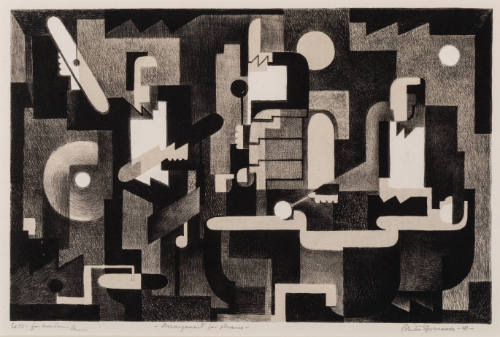
In 1928 a Cresson scholarship from PAFA enabled Spruance to spend several months in Paris with his wife. Spruance studied at the Académie Montparnasse under French painter André Lhote (1885–1962), a practitioner of the style known as cubism, in which forms are abstracted as series of their component planes and angles. He was introduced to lithography at the distinguished Paris print workshop of Edmond Desjobert (1888-1953), with whom he would later make many of his lithographs. On his return to Philadelphia, Spruance began working for an interior design firm; he also resumed part-time teaching at Beaver College (now Arcadia University), a private women's college in suburban Glenside, Pennsylvania, where he had taught beginning in 1926.
Spruance studied painting further with Lhote in Paris on a second Cresson scholarship in 1930. Although he continued to paint, he was most active as a printmaker. He exhibited widely and won numerous awards. In addition to teaching at Beaver, where he chaired the Department of Fine Arts from 1933 until his death, he joined the faculty at the Philadelphia Museum and School of Industrial Art. Spruance actively promoted the arts, for example by lobbying the Philadelphia City Council to set aside one per cent of the cost of new public buildings for fine art in 1959, a now-common practice in many cities in the United States. Spruance created more than five hundred prints.
In 1928 a Cresson scholarship from PAFA enabled Spruance to spend several months in Paris with his wife. Spruance studied at the Académie Montparnasse under French painter André Lhote (1885–1962), a practitioner of the style known as cubism, in which forms are abstracted as series of their component planes and angles. He was introduced to lithography at the distinguished Paris print workshop of Edmond Desjobert (1888-1953), with whom he would later make many of his lithographs. On his return to Philadelphia, Spruance began working for an interior design firm; he also resumed part-time teaching at Beaver College (now Arcadia University), a private women's college in suburban Glenside, Pennsylvania, where he had taught beginning in 1926.
Spruance studied painting further with Lhote in Paris on a second Cresson scholarship in 1930. Although he continued to paint, he was most active as a printmaker. He exhibited widely and won numerous awards. In addition to teaching at Beaver, where he chaired the Department of Fine Arts from 1933 until his death, he joined the faculty at the Philadelphia Museum and School of Industrial Art. Spruance actively promoted the arts, for example by lobbying the Philadelphia City Council to set aside one per cent of the cost of new public buildings for fine art in 1959, a now-common practice in many cities in the United States. Spruance created more than five hundred prints.