
George Copeland Ault
1891
–1948
BirthplaceCleveland, Ohio, United States of America
Death placeWoodstock, New York, United States of America
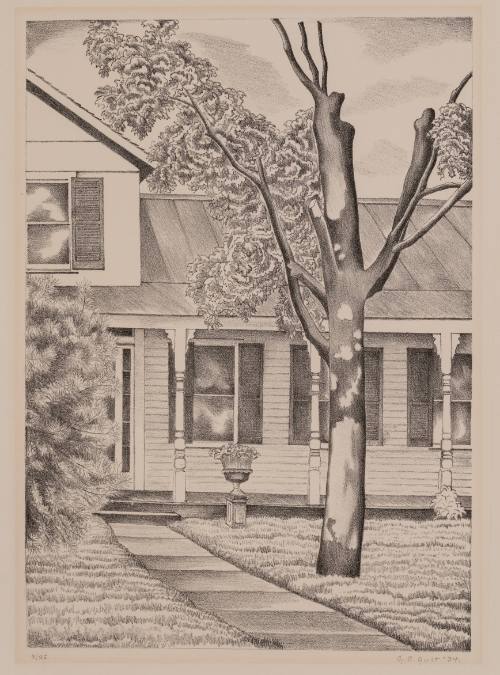
BiographyGeorge Ault created often mysterious images of cityscapes, interiors, and rural scenery, absent of people, in a range of styles inflected with precise lines and smoothly rounded forms. Ault's father was a businessman and patron of the arts in Cleveland, Ohio, who moved his family to London when Ault was a child and encouraged his interest in art. Ault attended the Slade School of Art at University College, London, and the St. John's Wood School of Art, and made several trips to Europe with his family before returning to the United States in 1911. Settling in a home and studio provided by his father in Hillside, New Jersey, Ault married, but he left his wife in 1922 to move to New York City. He soon was associated with emerging modernist styles, notably so-called precisionism, characterized by clean-edged forms and, in Ault's case, muted earth colors.
Ault exhibited at the Society of Independent Artists and spent several summers in the art colony at Provincetown, Massachusetts. The Downtown Gallery, an important venue for newer artists, began representing Ault in the late 1920s, when he was known for moody visions of urban buildings, especially rooftops scenes. The artist was left nearly destitute after the Stock Market crash of 1929, which wiped out his family's fortune, hastened his father's death from cancer, and led to the suicides of two of his brothers.
In the mid-1930s Ault worked for federal government-sponsored artists' relief projects and began spending summers in Woodstock, New York, in the Catskill Mountains region of southern New York State, long a popular artists' destination. In 1937, partly for financial reasons, he moved permanently to Woodstock with Louise Jonas, who became his second wife. Although Ault's later years were marked by poverty and hardship, he found new artistic challenges in the natural world and continued his focus on architectural forms, often showing them at night illuminated by a single, artificial light source. Both his representational works and the purely abstract compositions to which he increasingly turned contain elements of surrealism, the evocation of dream-like imaginings and fantasy. Ault died at the age of fifty-six from drowning.
Ault exhibited at the Society of Independent Artists and spent several summers in the art colony at Provincetown, Massachusetts. The Downtown Gallery, an important venue for newer artists, began representing Ault in the late 1920s, when he was known for moody visions of urban buildings, especially rooftops scenes. The artist was left nearly destitute after the Stock Market crash of 1929, which wiped out his family's fortune, hastened his father's death from cancer, and led to the suicides of two of his brothers.
In the mid-1930s Ault worked for federal government-sponsored artists' relief projects and began spending summers in Woodstock, New York, in the Catskill Mountains region of southern New York State, long a popular artists' destination. In 1937, partly for financial reasons, he moved permanently to Woodstock with Louise Jonas, who became his second wife. Although Ault's later years were marked by poverty and hardship, he found new artistic challenges in the natural world and continued his focus on architectural forms, often showing them at night illuminated by a single, artificial light source. Both his representational works and the purely abstract compositions to which he increasingly turned contain elements of surrealism, the evocation of dream-like imaginings and fantasy. Ault died at the age of fifty-six from drowning.