
Fitz Henry Lane
1804
–1865
BirthplaceGloucester, Massachusetts, United States of America
Death placeGloucester, Massachusetts, United States of America
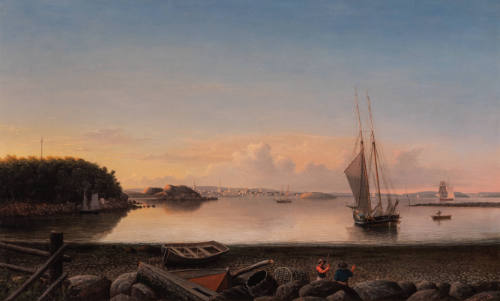
BiographyA well-known marine painter, Fitz Henry Lane favored flat coastal scenes painted with an emphasis on crystalline light effects and hushed serenity. Born Nathaniel Rogers Lane (a name he changed at age 27 to Fitz Henry Lane) in Gloucester, Massachusetts, the artist was the son of a sail maker. As a small child, Lane was partially paralyzed by illness, which closed off for him the usual maritime pursuits and may have spurred his interest in drawing.
Lane taught himself the rudiments of drawing as a boy, and took formal instruction as an apprentice in a lithographer’s shop in Boston. He took up painting in 1840 and portrayed the shoreline and harbor views around Boston Harbor and Cape Ann, Massachusetts. The following year, he began exhibiting his work in Boston and New York City. Lane’s series of paintings of Massachusetts harbors was published as lithographs, a form of reproductive print. His early works reflect his study of English and Dutch marine paintings and the works of English-born artist Robert Salmon (1775–circa 1845), then America’s leading marine painter.
Lane’s reputation as a marine painter was established by 1848, the year he returned permanently to his native Gloucester. He undertook a number of excursions by water, making repeated sketching trips to Maine, visiting New York City, and possibly sailing to Puerto Rico, but he never ventured to Europe, considered by many nineteenth-century American landscape painters an essential part of their training. Precluded by his disability from traveling to such popular landscape painting destinations as the mountainous interior of New England and the West, Lane drew his subjects from the coastal setting and life he knew intimately. His work was admired in his day for its accuracy in the representation of ships and their rigging. Harbor and beach scenes, portraits of vessels, and views of the New England shoreline countryside constitute almost Lane’s entire production. His late work, painted from the late 1850s on, is characterized by a new openness of composition, severity of style, dream-like subjects featuring symbolic devices such as wrecked vessels, and an attention to evocative light effects. In this period, Lane also took on several pupils who emulated his style, notably Mary Blood Mellen (1817–1886).
Lane taught himself the rudiments of drawing as a boy, and took formal instruction as an apprentice in a lithographer’s shop in Boston. He took up painting in 1840 and portrayed the shoreline and harbor views around Boston Harbor and Cape Ann, Massachusetts. The following year, he began exhibiting his work in Boston and New York City. Lane’s series of paintings of Massachusetts harbors was published as lithographs, a form of reproductive print. His early works reflect his study of English and Dutch marine paintings and the works of English-born artist Robert Salmon (1775–circa 1845), then America’s leading marine painter.
Lane’s reputation as a marine painter was established by 1848, the year he returned permanently to his native Gloucester. He undertook a number of excursions by water, making repeated sketching trips to Maine, visiting New York City, and possibly sailing to Puerto Rico, but he never ventured to Europe, considered by many nineteenth-century American landscape painters an essential part of their training. Precluded by his disability from traveling to such popular landscape painting destinations as the mountainous interior of New England and the West, Lane drew his subjects from the coastal setting and life he knew intimately. His work was admired in his day for its accuracy in the representation of ships and their rigging. Harbor and beach scenes, portraits of vessels, and views of the New England shoreline countryside constitute almost Lane’s entire production. His late work, painted from the late 1850s on, is characterized by a new openness of composition, severity of style, dream-like subjects featuring symbolic devices such as wrecked vessels, and an attention to evocative light effects. In this period, Lane also took on several pupils who emulated his style, notably Mary Blood Mellen (1817–1886).