
Henry Mosler
1841
–1920
BirthplaceNew York, New York, United States of America
Death placeNew York, New York, United States of America
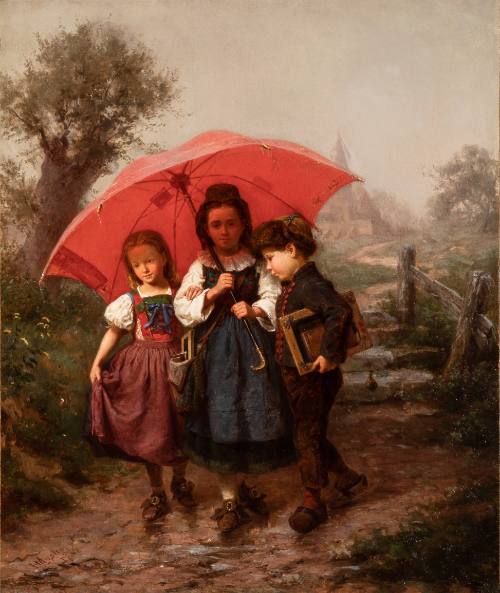
BiographyHenry Mosler’s highly detailed scenes of peasant life in the rural villages of the French province of Brittany appealed to his contemporary American viewers for their material specificity and popular themes. Mosler was born in Silesia, Prussia (now Poland), son of a German-Jewish lithographic artist who brought his family to the United States when the boy was eight years old. For unknown reasons, Mosler often claimed he was born in New York City. The family eventually settled in Cincinnati, where Mosler trained as a designer of lithographic prints. He received his first fine-art instruction from portrait and genre painter James Henry Beard (1811–93), under whose influence the young artist established himself as a portrait painter and an active participant in Cincinnati’s art scene.
During the Civil War, Mosler served in the Union army and also worked as an artist-correspondent for several journals, including Harper's Weekly. In 1863, he traveled to Düsseldorf, Germany, long an important art center, where he absorbed a solid technical training at the Royal Academy and began to focus on the themes of European peasant life that would become his specialty. He followed his two-year stay in Düsseldorf with six months of study in Paris with painter Ernest Hébert (1817–1908). When he returned to Cincinnati in 1866, Mosler found success as a painter of portraits and, with his marriage and growing family, introduced themes of childhood into his popular genre scenes.
In an effort to further his career, Mosler relocated to Munich in 1875 and after two years there moved to Paris, then emerging as the art capital of Europe. His works met critical and financial success both in Europe and at home. In 1879, his painting Le Retour, an interpretation of the biblical theme of the prodigal son in a Breton setting, was the first work by an American artist to be purchased by the French government. For the next two decades, Mosler continued to capitalize on the popularity of Breton peasant themes, exploring everyday life and folk customs, particularly those surrounding courtship marriage.
During his expatriate years, Mosler traveled widely in Europe and the Near East, returning to the United States for two extended stays. In 1885–86, he toured the American Southwest to make sketches for several paintings of Native Americans. He settled permanently in New York in 1894 and became a prominent member of the city’s art scene and a popular teacher. Mosler received considerable recognition for his art, including election as an associate member of the prestigious National Academy of Design, from which he resigned in 1906 after failing to be awarded full membership. Summering in the Catskill Mountains of New York State, Mosler took up landscape painting and explored such themes as colonial history and contemporary rural life in his late genre paintings.
During the Civil War, Mosler served in the Union army and also worked as an artist-correspondent for several journals, including Harper's Weekly. In 1863, he traveled to Düsseldorf, Germany, long an important art center, where he absorbed a solid technical training at the Royal Academy and began to focus on the themes of European peasant life that would become his specialty. He followed his two-year stay in Düsseldorf with six months of study in Paris with painter Ernest Hébert (1817–1908). When he returned to Cincinnati in 1866, Mosler found success as a painter of portraits and, with his marriage and growing family, introduced themes of childhood into his popular genre scenes.
In an effort to further his career, Mosler relocated to Munich in 1875 and after two years there moved to Paris, then emerging as the art capital of Europe. His works met critical and financial success both in Europe and at home. In 1879, his painting Le Retour, an interpretation of the biblical theme of the prodigal son in a Breton setting, was the first work by an American artist to be purchased by the French government. For the next two decades, Mosler continued to capitalize on the popularity of Breton peasant themes, exploring everyday life and folk customs, particularly those surrounding courtship marriage.
During his expatriate years, Mosler traveled widely in Europe and the Near East, returning to the United States for two extended stays. In 1885–86, he toured the American Southwest to make sketches for several paintings of Native Americans. He settled permanently in New York in 1894 and became a prominent member of the city’s art scene and a popular teacher. Mosler received considerable recognition for his art, including election as an associate member of the prestigious National Academy of Design, from which he resigned in 1906 after failing to be awarded full membership. Summering in the Catskill Mountains of New York State, Mosler took up landscape painting and explored such themes as colonial history and contemporary rural life in his late genre paintings.