
Helen Torr
1886
–1967
BirthplaceRoxbury, Pennsylvania, United States of America
Death placeBayshore, Long Island, New York, United States of America
BiographyHelen Torr, nicknamed “Reds" for her auburn hair, was born in Pennsylvania and studied at Drexel Institute in Philadelphia between 1902 and 1905. In 1906, she earned a scholarship to the Pennsylvania Academy of the Fine Arts, where she studied under William Merritt Chase. During her time there, she met and later married fellow artist Clive Weed (1884-1936).
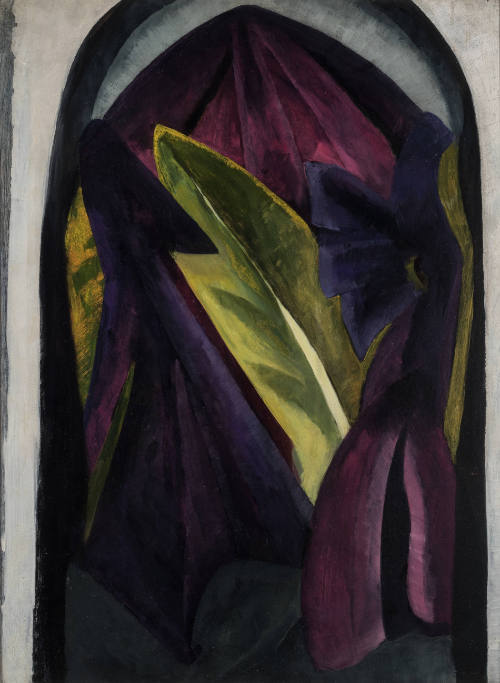
Torr played a quiet but significant role in the development of American modernism in the 1920s, largely through her long relationship and eventual marriage to artist Arthur Dove. The couple's circle included avant-garde artists such as Alfred Stieglitz (1864–1946), Georgia O'Keeffe, and Marsden Hartley. Her painitngs demonstrate an intense awareness of nature. She often depicted shells, rocks, and plant parts in flattened, glowing compositions that read as abstracted landscapes. Many of her strongest works blend folk art's stylized forms and patterns with precise details drawn from direct observation. Some pieces also reveal an affinity with collage and surrealist aesthetics.
Torr rarely promoted her work and seldom exhibited it. Two of her paintings were included in the 1917 Society of Independent Artists exhibition (under the name Helen Torr Weed); Georgia O'Keeffe included her in a group show at the Oppotunity Gallery in 1927; and Torr exhibited with Dove in 1933. After Dove's death in 1946, Torr ceased painting entirely.
Torr played a quiet but significant role in the development of American modernism in the 1920s, largely through her long relationship and eventual marriage to artist Arthur Dove. The couple's circle included avant-garde artists such as Alfred Stieglitz (1864–1946), Georgia O'Keeffe, and Marsden Hartley. Her painitngs demonstrate an intense awareness of nature. She often depicted shells, rocks, and plant parts in flattened, glowing compositions that read as abstracted landscapes. Many of her strongest works blend folk art's stylized forms and patterns with precise details drawn from direct observation. Some pieces also reveal an affinity with collage and surrealist aesthetics.
Torr rarely promoted her work and seldom exhibited it. Two of her paintings were included in the 1917 Society of Independent Artists exhibition (under the name Helen Torr Weed); Georgia O'Keeffe included her in a group show at the Oppotunity Gallery in 1927; and Torr exhibited with Dove in 1933. After Dove's death in 1946, Torr ceased painting entirely.