
John H. Twachtman
1853
–1902
BirthplaceCincinnati, Ohio, United States of America
Death placeGloucester, Massachusetts, United States of America
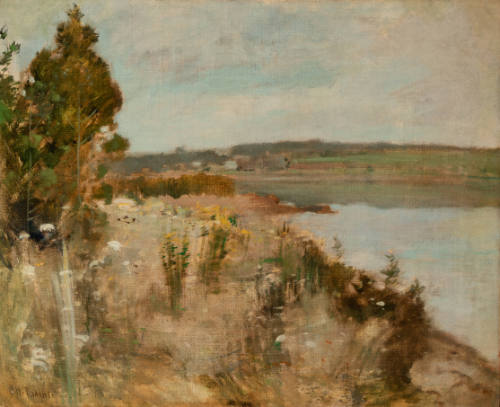
BiographyThe son of German immigrants, Twachtman grew up in a lively German neighborhood in Cincinnati, Ohio. He began his artistic training at the Ohio Mechanics' Institute and the McMicken School of Design. In 1874, he became a student of fellow Cincinnati painter Frank Duveneck, who had studied at the Royal Academy in Munich, Germany. Twachtman followed his teacher to Munich and enrolled in the progressive Royal Academy himself, later traveling with Duveneck to Venice for further study. By 1879, Twachtman had moved to New York and exhibited his painterly, Munich-inspired canvases with some success. During the early 1880s, he divided his time between Cincinnati and Europe: teaching at Duveneck’s art school in Florence in 1880; traveling with his wife, artist Martha Scudder (1861-1935), in 1881; and living in France from 1883 to 1885. During this period, his style evolved away from the dark tones and heavy paint application typical of the Munich manner. Instead, he created lighter, more atmospheric landscapes painted with thin layers of pigment. He also began experiementing with pastel, a medium then undergoing a revival, using its soft textures and subtle color transitions to explore simplified compositions with flat shapes and sinuous outlines, an approach influenced by Japanese woodcut prints.
In the late 1880s, Twachtman contributed to a cyclorama depicting the Battle of Gettysburg and began teaching in various settings, including Newport, Rhode Island, the Art Students LEague in New York, and the Cos Cob art colony in Connecticut. Though highly respected among his fellow artists, Twachtman never achieved widespread critical acclaim nor financial success. In 1889, he and his family settled on a farm in then-rural Greenwich, Connecticut. His home and its natural surroundings, particularly a small stream and waterfall, became the focus of his art for the rest of his career, painted in changing seasons and light. He also produced works in Gloucester, Massachusetts, and created commissioned landscapes of Yellowstone Park and Niagara Falls. In 1897, Twachtman joined a group of artists who split from the conservative Society of American Artists to form the more progressive group known as the Ten American Painters.
In the late 1880s, Twachtman contributed to a cyclorama depicting the Battle of Gettysburg and began teaching in various settings, including Newport, Rhode Island, the Art Students LEague in New York, and the Cos Cob art colony in Connecticut. Though highly respected among his fellow artists, Twachtman never achieved widespread critical acclaim nor financial success. In 1889, he and his family settled on a farm in then-rural Greenwich, Connecticut. His home and its natural surroundings, particularly a small stream and waterfall, became the focus of his art for the rest of his career, painted in changing seasons and light. He also produced works in Gloucester, Massachusetts, and created commissioned landscapes of Yellowstone Park and Niagara Falls. In 1897, Twachtman joined a group of artists who split from the conservative Society of American Artists to form the more progressive group known as the Ten American Painters.