
Charles Sprague Pearce
1851
–1914
BirthplaceBoston, Massachusetts, United States of America
Death placeParis, France
BiographyCharles Sprague Pearce painted highly finished figural images on various themes ranging from the Bible to traditional European peasant life. Born in Boston, Pearce was the grandson and namesake of Charles Sprague (1791-1875), an American poet. He studied in Paris rathern than Munich on the advice of William Morris Hunt, a champion in the United States of contemporary French painting. Pearce arrived in the French capital in 1873 to study under academic painter Léon Bonnat (1833–1922), whose peasant subjects and emphasis on clearly modeled figures greatly influenced him. Ill health forced Pearce to spend several winters in the warm climate of the Mediterranean region. Visiting North Africa with artist Frederick A. Bridgman (1847–1928), Pearce was inspired to follow the current fashion for so-called orientalist and biblical settings and themes in his paintings. His Beheading of St. John the Baptist (1881; unlocated), for example, won an honorable mention at the prestigious Salon exhibition in Paris and a gold medal at the Pennsylvania Academy of the Fine Arts in Philadelphia. Beginning in 1876, Pearce exhibited his paintings widely in both France and the United States, with considerable success.
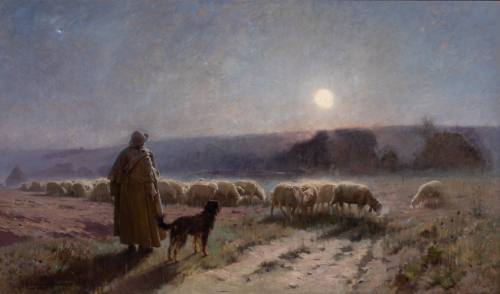
Like many of his contemporaries, Pearce came under the influence of the arts of Japan, portraying figures in Japanese clothing and adopting stylistic features found in Japanese prints, like abstract surface pattern or tipped-up perspective. In the early 1880s, he began visiting the French countryside, depicting scenes from everyday life using diffused lighting and cool colors that reflect the example of French painter Jules Bastien-Lepage (1848–1884). Many of these works combine carefully studied material detail and religious themes. In 1885, Pearce moved from Paris to the nearby village of Auvers-sur-Oise, the source for many of his rustic subjects. There, he purchased a house to which he added a glass-walled studio so that he could paint in outdoor light regardless of season and weather.
Active in the American expatriate art scene in France, Pearce was a juror for the Exposition Universelle in Paris in 1889, and he chaired the Paris advisory committees for the World's Columbian Exposition in Chicago in 1893 and the Louisiana Purchase Exposition in St. Louis in 1904. Although a permanent resident of France, he made several return visits to the United States. In the 1890s, he was one of the artists selected to paint murals in the new building for the Library of Congress in Washington, D.C. By the time Pearce ceased painting, around 1909, he had received a considerable number of awards and honors.
Like many of his contemporaries, Pearce came under the influence of the arts of Japan, portraying figures in Japanese clothing and adopting stylistic features found in Japanese prints, like abstract surface pattern or tipped-up perspective. In the early 1880s, he began visiting the French countryside, depicting scenes from everyday life using diffused lighting and cool colors that reflect the example of French painter Jules Bastien-Lepage (1848–1884). Many of these works combine carefully studied material detail and religious themes. In 1885, Pearce moved from Paris to the nearby village of Auvers-sur-Oise, the source for many of his rustic subjects. There, he purchased a house to which he added a glass-walled studio so that he could paint in outdoor light regardless of season and weather.
Active in the American expatriate art scene in France, Pearce was a juror for the Exposition Universelle in Paris in 1889, and he chaired the Paris advisory committees for the World's Columbian Exposition in Chicago in 1893 and the Louisiana Purchase Exposition in St. Louis in 1904. Although a permanent resident of France, he made several return visits to the United States. In the 1890s, he was one of the artists selected to paint murals in the new building for the Library of Congress in Washington, D.C. By the time Pearce ceased painting, around 1909, he had received a considerable number of awards and honors.