Remind
Artist
Rose B. Simpson
(born 1983)
Date2022
MediumClay, steel, grout, lava beads
Dimensions66 x 35 x 15 in.
Credit LinePurchased jointly by the National Museum of the American Indian, Smithsonian Institution, Washington DC and the Terra Foundation for American Art
Object numberTCA2025.1
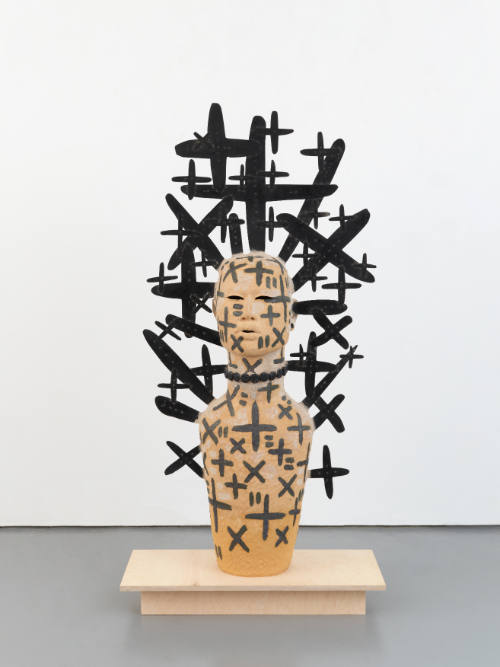
InterpretationPainted black crosses, plus signs, and parallel lines cover the clay torso and head of Rose Simpson’s 2023 sculpture Remind, while large and small black steel crosses protruding from the sides and top of the sculpture reach out and up in a dynamic, halo-like armature. Simpson has shared that the plus signs relate to the four cardinal directions, while the X’s represent protection. Her ceramics all share motifs and symbols of her own creation that communicate protection, adornment, and the act of witnessing.
Simpson created Remind using a pottery technique she developed that she calls “slap-slab," a dynamic form of slab sculpture—a process whereby a ceramic vessel is hand-built versus thrown on a pottery wheel—that involves slapping the clay on the floor several times to make it very thin, before applying it to the work-in-progress. All of Simpson’s sculptures, including Remind, bear evidence of its production, with visible fingerprints and the rough texture of clay that has been manipulated and pieced together by hand.
Remind is an evolution from Simpson’s earlier warrior sculptures, clay human-like figures dressed and posed in stances prepared seemingly for some kind of battle. In contrast, Remind has no arms and its face exudes a calm demeanor. While not as visibly active as the warrior sculptures, none of Simpson’s sculptures are static; she has emphasized that her sculptures are vessels that hold space for experience and understanding and are “busy in an energetic or spiritual way." The lava-bead necklace that the figure in Remind wears signals a shift from the more aggressive postures of Simpson’s earlier works toward present and future notions of positivity, awareness, and freedom.
Simpson created Remind using a pottery technique she developed that she calls “slap-slab," a dynamic form of slab sculpture—a process whereby a ceramic vessel is hand-built versus thrown on a pottery wheel—that involves slapping the clay on the floor several times to make it very thin, before applying it to the work-in-progress. All of Simpson’s sculptures, including Remind, bear evidence of its production, with visible fingerprints and the rough texture of clay that has been manipulated and pieced together by hand.
Remind is an evolution from Simpson’s earlier warrior sculptures, clay human-like figures dressed and posed in stances prepared seemingly for some kind of battle. In contrast, Remind has no arms and its face exudes a calm demeanor. While not as visibly active as the warrior sculptures, none of Simpson’s sculptures are static; she has emphasized that her sculptures are vessels that hold space for experience and understanding and are “busy in an energetic or spiritual way." The lava-bead necklace that the figure in Remind wears signals a shift from the more aggressive postures of Simpson’s earlier works toward present and future notions of positivity, awareness, and freedom.
Gallery installation, National Museum of the American Indian, New York City, New York, June 2025 - present.
Daniel Fuller, “Rose B. Simpson: Where Clay Runs Deep,” Upstate Diary, no. 16. [2023] Ill. (color).
Jack Shainman Gallery, New York, New York, 2022
Purchased jointly by the National Museum of the American Indian, Smithsonian Institution, Washington DC and the Terra Foundation for American Art, 2025