
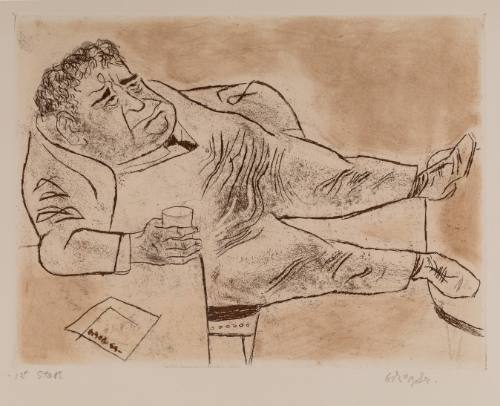
William Gropper
1897
–1977
BirthplaceNew York, New York
Death placeManhasset, New York
BiographyWilliam Gropper was a social realist artist and political caricaturist who used his distinctive style of bold, often angular lines to convey his outrage at social injustice. Born into a large, impoverished Jewish immigrant family in New York City, Gropper left high school to work as a dishwasher and delivery boy. In 1912, he began taking evening classes with realist artists Robert Henri and George Bellows at the recently opened Ferrer School, founded on the ideal of working-class liberation. From 1915 to 1917, a scholarship funded Gropper's studies at the New School of Fine and Applied Arts (now Parsons The New School for Design) in New York. After his studies, Gropper worked as an illustrator for the New York Tribune, but the newspaper's conservatism forced his departure two years later. Over the next three decades, he developed a successful freelance career in satiric illustration, starting with political cartoons for the leftist journal Rebel Worker. He provided political caricatures for many other periodicals, including The New Masses and The Sunday Worker, both associated with the workers' rights movement. Skilled in graphically satirizing authority and defending the underdog, Gropper pursued painting as well as drawing.
In 1927, Gropper accompanied writers Theodore Dreiser and Sinclair Lewis to Russia for the tenth anniversary of the October Revolution. He remained there for one year, touring and sketching in the USSR and stopping in Paris before returning to New York. During the 1930s, under the auspices of the government-sponsored relief program known as the WPA, Gropper completed post office murals. The 1930s brought him recognition: he held his first major solo painting exhibition in 1936 at New York's ACA Gallery. He also sold paintings to both the Metropolitan Museum of Art and the Museum of Modern Art, and he earned a Guggenheim Fellowship in 1937 to travel to the American Plains and Far West, sketching the poverty of rural life in the so-called Dust Bowl and the construction of major dams. He acquired a lithography press and began to make print editions. During World War II, he created works attacking Nazism. Between 1948 and 1950, after attending the Wroclaw Congress of Intellectuals for Peace in Breslau, Poland, Gropper traveled and exhibited in Russia, Czechoslovakia, Poland, and Bulgaria.
In 1953, during the height of American anti-communist fervor, Gropper was blacklisted for his socialist leanings and his art sales decreased. In response, he created his satirical Caprichos (in homage to Spanish artist Francisco Goya [1746-1928]), a series of fifty lithographs. Gradually Gropper's career revived, with exhibitions in Mexico, Europe, and New York and elsewhere in the United States. In the 1960s, he focused on making etchings, of which he eventually produced more than 160. In 1967, Tamarind Lithography Workshop (then in Los Angeles) invited him to create color lithographs; six years later, the political scandal known as Watergate inspired his final lithography series, devoted to senators and hearings. Gropper was elected to the National Institute of Arts and Letters in 1968.
In 1927, Gropper accompanied writers Theodore Dreiser and Sinclair Lewis to Russia for the tenth anniversary of the October Revolution. He remained there for one year, touring and sketching in the USSR and stopping in Paris before returning to New York. During the 1930s, under the auspices of the government-sponsored relief program known as the WPA, Gropper completed post office murals. The 1930s brought him recognition: he held his first major solo painting exhibition in 1936 at New York's ACA Gallery. He also sold paintings to both the Metropolitan Museum of Art and the Museum of Modern Art, and he earned a Guggenheim Fellowship in 1937 to travel to the American Plains and Far West, sketching the poverty of rural life in the so-called Dust Bowl and the construction of major dams. He acquired a lithography press and began to make print editions. During World War II, he created works attacking Nazism. Between 1948 and 1950, after attending the Wroclaw Congress of Intellectuals for Peace in Breslau, Poland, Gropper traveled and exhibited in Russia, Czechoslovakia, Poland, and Bulgaria.
In 1953, during the height of American anti-communist fervor, Gropper was blacklisted for his socialist leanings and his art sales decreased. In response, he created his satirical Caprichos (in homage to Spanish artist Francisco Goya [1746-1928]), a series of fifty lithographs. Gradually Gropper's career revived, with exhibitions in Mexico, Europe, and New York and elsewhere in the United States. In the 1960s, he focused on making etchings, of which he eventually produced more than 160. In 1967, Tamarind Lithography Workshop (then in Los Angeles) invited him to create color lithographs; six years later, the political scandal known as Watergate inspired his final lithography series, devoted to senators and hearings. Gropper was elected to the National Institute of Arts and Letters in 1968.